
2026.08.16 | Sacred Rest: The Creative Impulse
“Sacred Rest: The Creative Impulse”
Genesis 1:1-5
Preached by
Rev. Brenda Loreman
Eden United Church of Christ
Cherryland, CA
16 August 2026
It is 1982, the summer after I graduated from high school. I am 18, and my three friends and I are power-walking through the Louvre museum, as one does when one has allotted only three hours to see a museum that has a collection of over 500,000 art objects. In this museum full of famous paintings, we are fixated on making our way to perhaps THE most famous painting. We stride through the galleries without pausing. But in one gallery, out of the corner of my eye, I notice a painting that draws my attention. I turned to look at it, and it seems as though time stops. I am totally captivated. I’ve never seen a reproduction of the painting before, and I have no idea who the artist is, but there’s something about it that draws me in. Something about the contrast of light and dark, something about the main figure that I see in the painting, something about the quietness of the scene that makes me—compels me—to stop and notice. Time seems to stop for a moment. As I remember this moment in my mind’s eye, all the sound in the room disappears. All the voices, the movement fade away. And I am alone in the room with this painting.
My friends are now in the next gallery and one of them turns, looks at me, and calls to me to hurry up. The spell is broken. I turned from the painting and power walk my way with my friends to see the Mona Lisa. I did not return to the painting that so captivated me, because, you know – we had to go see the Venus de Milo next. So I didn’t learn the name of the painting or who painted it. But in the days and weeks and years to come, this moment lingered in my mind. Something about the painting had shifted something about me.
A few months later, I’m a freshman in college. I’m strolling across the main quad on campus, a large grassy and paved area where vendors often set up booths to sell their wares. I have some time to kill before my next class, and I stop where a guy has set up a number of bins full of art prints. I flip through the offerings in the three-dollar bin because, well that’s what a freshman in college can afford. And there it is—the painting! I grab it and look at it again, seeing it again for the first time since that moment half a world away. At the bottom is the title and the name of the painter: Georges de la Tour. The painting's title is “Saint Joseph, Carpenter.” Sometimes, I would later learn, it is more aptly titled “Christ in the Carpenter’s Shop.” It is a portrait of the child Jesus holding a candle and shielding it with his hand. The light bleeds through the fingers of his hand and totally suffuses his face with light. In fact, his lit face is the brightest thing in the painting. It’s as though his whole face is lit from within instead of from the light of the candle. His earthly father, Joseph, is there in the shop with him and is working on drilling a piece of wood, a beam lying on the floor he puts his foot on to steady. The look on Joseph’s face, which is not as well lit as that of Jesus, is solemn, pensive. He has a faraway look in his eyes and seems lost in thought, while Jesus by contrast looks alert and focused and, well—divine.

Of course I bought the print. I brought it home, and I didn’t even bother framing it. I just taped it to my wall and it stayed with me and worked on me for years. With the painting on my wall, I could look at it, gaze into its world, and feel again that feeling of time stopping, of the world disappearing a little. In contemplating the painting and remembering the experience—even for a few moments—I would feel a little calmer, a little refreshed, and a little inspired.
The contemplation of works of art has a long history in Christianity – and in other faiths as well. In a world where very few people knew how to read, artwork— painting, sculpture, stained glass—became a way to teach the stories of the Bible. The medieval Gothic cathedrals filled with art were essentially visual Bibles that could be read by the people who entered them. The stories of the saints might be told in the stained glass windows. The story of the passion of Christ might be told in sculpture arranged around the altar. The nativity story would be set up every year in the days leading up to Christmas. Icons of biblical figures and saints were used, especially in Eastern Christianity, as a practice of prayer and devotion. The formal practice of sacred seeing, or visio divina, began when Saint Benedict, a monk who lived around the year 500, brought forth the idea of visualizing the meaning of scripture through icons, paintings, or holy objects. Without realizing what I was doing, I began a practice of visio divina all those years ago with the painting of Christ in the carpenter’s shop. In visio divina, the idea is not to come to a work of art to dissect its composition and analyze its artistic merit, but to learn to “see with the eyes of the heart,” rather than the eyes of the mind. We bring a sense of openness and curiosity to the work, allowing our eye to travel and fall where it feels drawn and listen for what God might be saying to us through the creativity of the artist.
Even works of art that are not religious in their subject matter can become ways of refreshing the spirit, finding a sense of calm, inspiring our own creativity, and resting with God.
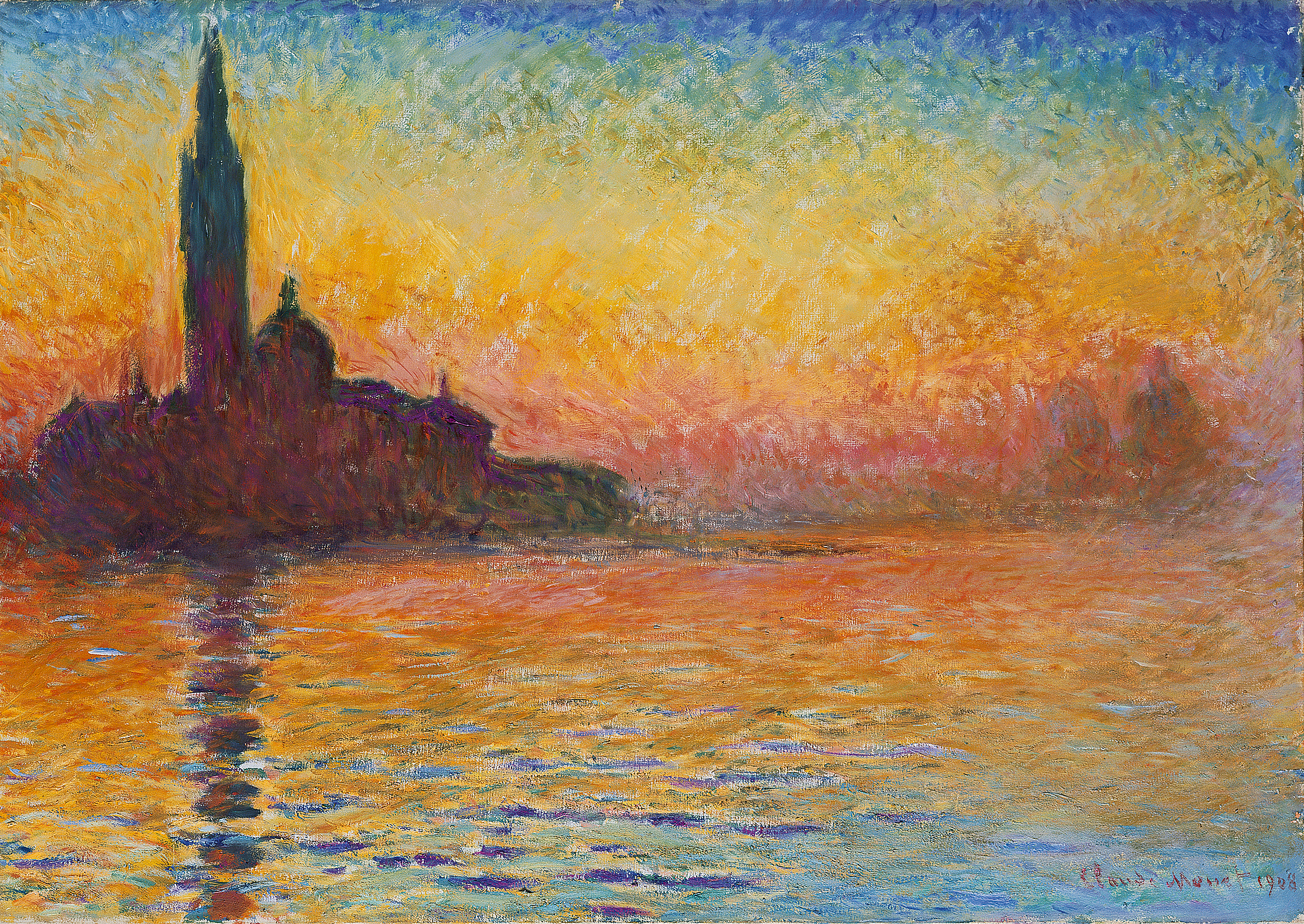
One of the ways I observed sacred rest during my vacation time last month was through visiting three different art museums and practicing some sacred seeing. Mike and I went to the Monet and Venice exhibit at the De Young museum, visited the Crocker museum in Sacramento for the first time, and also took in the Cantor Art Center at Stanford University, which is free to attend. Each museum offered many opportunities to see paintings I had never seen in person before and discover new artists and works of art. By the end of my vacation, I found myself both full and empty, rested and energized all at the same time. Here’s a sample of some of the pieces I found captivating:
The first is a work by Claude Monet that I had never seen before. I’m accustomed to seeing Monet’s works in pastels and watery colors, painted during the day, so this painting at sunset is striking in its saturated colors. I was very drawn to it, so much so that I bought a postcard of it to take home. I have it posted where I see it every day to remind me to pause and look with the eyes of my heart for a few moments.
I haven’t seen the latest movie of the Odyssey yet, but I found this painting of Penelope at the Crocker Museum in Sacramento. Something about it compels me to linger and wait along with her.
This was Mike’s favorite painting from the Crocker. You might be able to guess why. This is called “Pies, Pies, Pies” by Wayne Theibaud, who’s probably best known for his paintings of pastries and sweets.
One reason I wanted to go to the Cantor museum at Stanford was that they had a show of baskets by the Passamoquoddy indigenous American artist named Jeremy Frey. This is an example of one; I’ve never seen such amazingly intricate and beautiful baskets.
It makes sense to me that art and creativity—both contemplating works of art, and the creative making of art ourselves—is a way that we can find sacred rest in the divine. Because as scripture shares with us, God‘s first impulse is a creative impulse and the creation of what is good and beautiful. In the beginning when everything was chaos, God moved over the waters of the deep and created light and dark, created day and night, and called it good. As we know, the story goes on to tell us of all the beautiful things that God creates. And God creates us in God‘s image; we are given that creative impulse of God. So one way to find sacred rest is to rest in creativity.
Visio Divina
I invite you now to experience sacred rest as we practice visio divina together for a few moments. You can view the image on the screen, or, if you prefer, look at the photocopied version where you’re seated. There are a few copies in each pew.
Les invito ahora a experimentar el descanso sagrado mientras practicamos juntos visio divina por unos momentos. Pueden ver la imagen en la pantalla o, si lo prefieren, mirar la versión fotocopiada que está donde están sentados. Hay algunas copias en cada banca.
Settle yourself in a comfortable position. We're going to spend some time simply looking — not analyzing, not figuring anything out. Just noticing. There's nothing to get right here. Whatever rises in you as you look is enough.
Acomódense en una posición cómoda. Vamos a pasar un tiempo simplemente mirando — sin analizar, sin tratar de entender nada. Solo notando. No hay nada que deba hacerse "correctamente" aquí. Lo que sea que surja en ustedes al mirar, es suficiente.
Let's take a breath together. Respiremos juntos. Breathe in... and out. And again… una mas. Inhalen... y exhalen.
Let your eyes rest on the painting. Dejen que sus ojos descansen sobre la pintura.
For the next few moments, simply look. Take a few moments to allow your eyes to wander over the whole landscape of the image, exploring all of its shapes, colors, contours, and details. Simply be present to the image and allow it to speak to your heart, without any particular agenda.
Por los próximos momentos, simplemente miren. Tómense unos momentos para dejar que sus ojos recorran todo el paisaje de la imagen, explorando todas sus formas, colores, contornos, y detalles. Simplemente estén presentes en la imagen y permitan que le hable a su corazón, sin ninguna agenda en particular.
Gradually notice if there is a place in the image where your eye is being invited to rest…. What is the place in the image that is calling to you—is it a tree, the sky? The fields, a color? Take a few moments to simply be present to this in a gentle way.
Poco a poco, noten si hay un lugar en la imagen donde su mirada se sienta invitada a descansar… ¿Cuál es el lugar en la imagen que les está llamando —es un árbol, el cielo? ¿Los campos, un color? Tómense unos momentos para simplemente estar presentes a esto de una manera suave.
As you gaze at the image, notice your breath and your body.
Mientras contemplan la imagen, noten su respiración y su cuerpo.
How do you feel looking at the painting? Does it evoke a memory?
¿Cómo se sienten al mirar la pintura? ¿Les evoca algún recuerdo?
If you were in the image, where would you place yourself ?
Si estuvieran dentro de la imagen, ¿dónde se ubicarían?
Do you get a glimpse of the sacred from this image? Is God speaking to you in this image?
¿Vislumbran algo de lo sagrado en esta imagen? ¿Les está hablando Dios a través de esta imagen?
Let’s rest in silence a little longer. No more prompts — just you, and the painting, and whatever has surfaced.
Descansemos en silencio un poco más. Sin más indicaciones — solo ustedes, la pintura, y lo que haya surgido.
As we come out of this silence, we don't need to have found a tidy meaning. Sometimes the gift of looking is simply the looking itself — a few minutes of being fully present to beauty, to movement, to stillness.
Al salir de este silencio, no necesitamos haber encontrado un significado ordenado. A veces el regalo de mirar es simplemente el hecho de mirar — unos minutos de estar plenamente presentes a la belleza, al movimiento, a la quietud.
May whatever stirred in you during this time continue to unfold in its own way, in its own time.
Que lo que se haya movido en ustedes durante este tiempo continúe desplegándose a su propio modo, en su propio tiempo.
Tomemos una respiración más juntos, y regresemos suavemente. Amén.
Let's take one more breath together, and gently return. Amen.