
@EUCC Sermons
TO WATCH LIVE ON SUNDAY AT 10 AM, CLICK on VIMEO
2026.06.21 | Shadrach, Meshach, and Abednego
This week in our Faces of Faith series we consider the remarkable tale of Shadrach, Meshach and Abednego from the book of Daniel. It is a story where the main characters are challenged, face intense tribulations, but remain true to YHWH and are profoundly rewarded for their faithfulness. But we first need to look at the context of their story.
In 597 BCE, the Babylonian King Nebuchadnezzar II declared war and laid siege to the city of Jerusalem, capital of the Kingdom of Judah. Jerusalem surrendered and the Babylonian army laid waste to the city, setting much of it on fire. Nebuchadnezzar issued a decree that all smart and capable Israelites be brought to Babylon. So its King Jehoiachin (Juh-HOH-wuh-kihn) was carried off, along with members of the royal household and many sacred treasures. Among the first wave of captives were four young men from the house of David named Daniel, Hananiah, Mishael, and Azariah. Scripture tells us that “God gave these four young men knowledge and skill in both books and life.”
They were brought to Babylon to be trained for a period of three years, after which they would be compelled into King Nebuchadnezzar’s service. They were given new names that honored Babylonian deities: Daniel was named Belteshazzar, Hananiah was named Shadrach, Mishael was named Meshach, Azariah was named Abednego.
So they had lost their country, their homes, their way of life, their families, their language, and even their names. They were now living in a strange land, the land of their conquerors and were required to serve King of the captors.

2026.06.14 | The Daughters of Zelophehad
In the catalog of memorable biblical characters, the daughters of Zelophehad are definitely not at the top of the list. In fact, I’m willing to guess that until today, most of you had never heard of them. Am I right?
Don’t feel bad about that—they are definitely not what Pastor Marvin called “headliners” last week. Their story does not appear in the Revised Common Lectionary, and I have never seen a stained glass image or classical religious painting of Mahlah, Noah, Hoglah, Milcah, and Tirzah. I have never heard a sermon preached about these daughters, and, although I have read the entire book of Numbers, I really have no memory of encountering the daughters in my reading.
And yet, their story is not insignificant. In addition to today’s text from Chapter 27, they are mentioned briefly in Chapter 26 of Numbers, and again in Chapter 36. And they appear yet again in Chapter 17 in the book of Joshua, after the Israelites have conquered the promised land and the land is being apportioned to the twelve tribes. The daughters show up and confront Joshua and the priest Eleazar, and make sure that they remember that God commanded that they be given their father’s inheritance. And it was given to them.
In the patriarchal structure of biblical-era society, property passed from father to son. Women and girls had to rely on their male family members for subsistence and protection. Widows without sons and unmarried daughters without a father or brothers were the most vulnerable in such a community. They had no power and no advocate, and—one would think—no voice.
And yet, these five sisters had courage. They stood up and marched right up to the entrance of the meeting tent and confronted what they saw as an unjust system. “Why should the name of our father be taken away from his clan because he had no son?” they said. “Give to us a possession among our father’s brothers.” Notice that they didn’t weep or ask or beg. They demanded! These disenfranchised women confronted what was unjust, demanded justice for themselves, and proposed a more equitable law—one that would benefit not only these five sisters, but generations of women to come.
These daughters represented the least powerful in their community, and yet they dared to challenge the tradition of the patriarchy.
2026.06.07 | Faces of Our Faith: Eutychus
But if you actually read Scripture, you discover that God seems to have a particular affection for ordinary people. People who appear for only a few verses. People who never preach a sermon or never perform a miracle.
A servant girl. A widow with two coins. A boy with five loaves and two fish. A nameless woman who reaches out and touches the hem of Jesus' garment. They often show up for just a moment. And yet without them, the story itself would be different, lacking even.
I think that's important because sometimes we imagine that faithfulness belongs to the extraordinary. We tell ourselves, "I'm not a pastor. I'm not a theologian. I'm not a saint. I'm just an ordinary person trying to live a good life."
But the good news of Scripture is that God has always been in the business of working through ordinary people. The kingdom of God is built not only by famous leaders, but by everyday acts of courage, kindness, persistence, hospitality, and hope. We are a priesthood of all believers.
In fact, if the Bible teaches us anything, it is that there really are no "minor" characters. There are only people whose stories we have not paid enough attention to.
Cuando pensamos en la Biblia, pensamos en los protagonistas principales: Moisés, David, Pedro, Pablo, María y Jesús; los grandes nombres.
Pero si realmente leemos las Escrituras, descubrimos que Dios tiene una manera especial de obrar a través de personas comunes. Una joven sirvienta. Una viuda con dos monedas. Un niño con cinco panes y dos peces. Una mujer sin nombre que extiende la mano para tocar el manto de Jesús. Puede que aparezcan solo por un instante, pero sin ellos, la historia sería diferente.
Y tal vez eso sea una buena noticia para nosotros. Porque a veces pensamos que la fidelidad es algo propio de lo extraordinario. Sin embargo, una y otra vez, Dios obra a través de personas comunes y de actos cotidianos de valentía, bondad y esperanza.
Quizás no existan realmente personajes «secundarios» en la historia de Dios, sino solo personas a cuyas historias no hemos prestado suficiente atención.
2026.05.31 | Babel to Belonging
"Come, let us build ourselves a city and a tower with its top in the heavens, and let us make a name for ourselves; otherwise we shall be scattered abroad upon the face of the whole earth." The fear is not failure. The fear is difference. The fear is dispersion. The fear is the world in all its wild, ungovernable variety. Empire always fears difference. Empire prefers one language, one story, one identity, one sexuality, one center of power. Not merely a shared tongue, but a shared way of naming reality. A shared hierarchy of values. A shared understanding of who belongs and who does not. Empire demands sameness.
Babel is not ultimately a story about human beings reaching too high. It is a story about what happens when uniformity and supremacy become idols. The tower is not merely an architectural achievement — it is an imperial project, a monument to the dream of one city, one name, one way of being human. And so God does what God has always done when imperial power consolidates around sameness: God scatters. God diversifies. God insists that the earth is wider than any tower can contain.
The confusion of tongues is not God's punishment for diversity. It is God's protection of diversity.
En la historia de Babel, toda la humanidad se reúne en un solo lugar, con un solo idioma y una identidad compartida. Juntos construyen una torre, con la esperanza de hacerse un nombre y evitar ser dispersados por toda la tierra.
A menudo interpretamos esto como una historia sobre el orgullo: personas que aspiran demasiado alto y a las que Dios castiga confundiendo sus lenguas. Pero, ¿y si nos hemos estado planteando la pregunta equivocada?
2026.05.24 | ALL FLESH
Fifty days after the resurrection, during the Festival of Weeks, the Holy Spirit makes a dramatic entrance to proclaim her acceleration of the new creation! Whereas the presence of the Spirit had appeared as a pillar of fire while the Hebrew people followed the prophet Moses through the desert toward a new beginning, now the Holy Spirit lighted on each of them appearing as a fiery tongue that did not burn. As people’s languages had morphed and been confused at the Tower of Babel, now they spoke in different languages but understood one another. And it didn’t matter who they were or where they were from, everyone present was blessed with these gifts. God’s spirit was poured out on all flesh, just as the prophet Joel foretold. THESE were the signs of the New Creation manifesting! And thus, the Holy Spirit became the active presence of God in all of our lives, empowering and transforming believers to love God, love others and work toward co-creating a world full of God’s shalom and life-giving Spirit.
So where do we see the Holy Spirit today? What does the Spirit do exactly? What are roles does she play in our lives?

2022.02.13 | Reclaiming the Ministry of Healing
I reached out, held Brad’s hands, and said, “You can count us. We will pray for you and with you.” And we did. I prayed with Brad in my office that day. Together we launched an AIDS Prayer group for others who were living with this disease, for partners and other loved ones, for health care workers, and for those who identified as the “worried well.”

2021.09.05 | Beyond Parochialism
Like other humans, Jesus had to be challenged to think outside of the box that he had grown up in. He had to be challenged to try the food, speak the language, and imagine that the ways of his people might not be the only ways to believe or to do things.
In short, Jesus had to be healed of his parochialism, before he could expand and fulfill God’s calling to be the hope and healer of all nations.
The great irony of this story is that the tables are turned twice. Instead of Jesus instantly fulfilling the Syrophonecian’s request that he heal her daughter from the unclean spirit, Jesus has to be healed of his parochialism.
He couldn’t heal himself. He needed the help of a foreign-born, non-native speaker, from a different faith tradition. So in the end, four miracles unfold in Mark 7. . .

2021.08.08 | Taste and See
Unless a person has experienced doubt, can they claim to have faith? Unless a person has felt despair, can they really know joy? Unless a person has gone without, can they truly be thankful? I don’t think so.
That’s why Psalm 34 is so powerful. It’s tried and true. It’s been taste-tested by our ancestors in the faith.
As a consequence, we can trust the veracity of these verses, and hold onto the hope that they exude, even when we may not yet be able to proclaim the words of Psalm 34 with our whole hearts.

2021.07.11 | The Metrics of Justice
Today we are celebrating the 26th Anniversary of our Open & Affirming recognition by the UCC Coalition for Lesbian, Gay, Bisexual, and Transgender Concerns--aka “the Coalition.”
Eden Church is out and proud to be on the forefront of the LGBTQQI justice movement, and part of the fastest growing welcoming church movement in the world!
In 1995 we received this honor in recognition of the year-long study and decision-making process that our church participated in, which included the adoption of our ONA declaration. We were the 159th congregation out of about 6,000 congregations in the United Church of Christ to complete this process and to be recognized in this way.

2020.09.20 | This Bread God Gives
Think back to 2019: what you were complaining about last year? The weather, your work, being unable to buy something or being unable to go somewhere. How does that compare to this year: when what we are complaining about boils down as much to survival as it did for the Israelites: will I get sick, will someone I love get sick, will my job last, can I get unemployment benefits, will my house be destroyed by wildfire?
Daily, 2020 reminds us that our complaints in 2019 were probably not nearly as real or as important as they are today. And the Bible reminds us that God hears and sees and is present with us, both yesterday and today. Like the Israelites, it may be time for us to make it a practice to be more discerning about what we complain about and where we focus our energies when we are in a time of transition.
2020.09.06 | Remember
“As descendants of Abraham, we must re-member. We must put together the stories that were handed to us. We must claim them as our own, and we must understand our roles in confronting modern-day Pharaohs, claiming our power, and engaging in liberation movements that would set all people free.“

2020.08.30 | I Am
2020 has thrown some hard stuff at us: COVID-19 and the inequities in our society that it has laid bare; the continued empowerment of white supremacy by our current president and the evils it manifests in our streets and neighborhoods; the dismantling of a already inadequate immigration system; the overwhelming of our dysfunctional healthcare system; climate change and the droughts and wildfires that come with it; even distanced learning. All of which disproportionately affects the poor and people of color. At times it seems all we can do is cry out. And that’s where our story begins this morning.

2020.07.19 | Finding God in Strange Places
“I wonder, have you ever been surprised by where God has shown up in your life?
To answer this question, let’s first consider where it is that we expect God to show up. I imagine that most people expect God to show up in Church. Right?
I think this is why the Shelter-In-Place order is so difficult for many Christians to accept. In this tipsy-topsy world, people of faith would like nothing more than to be in worship—in a familiar place, singing familiar songs, saying familiar prayers with familiar people—so that we might reground ourselves in the knowledge that God is in charge, and that everything is going to be OK.
But then, lo and behold, the County Health Officer and the Governor start pulling back the reins on phasing out Phase 1. . .”
2020.07.05 | A Good Place for Confession
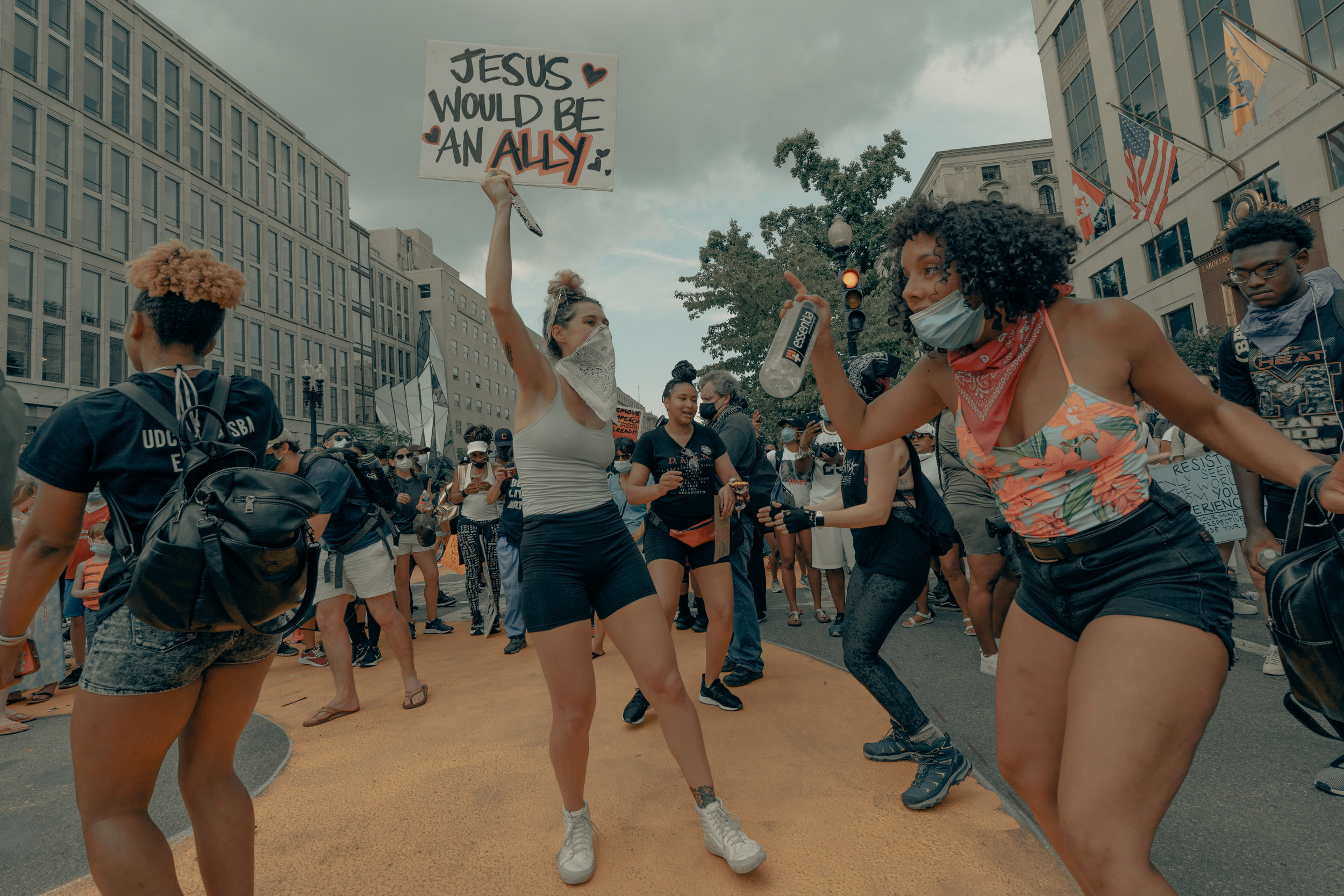
In addition to confessing that racism is America’s original sin, it’s also necessary for us to acknowledge that the Christian Church has a lot of racism to confess, and that congregations like ours (that come out of a Liberal Protestant tradition) aren’t too enthralled with confession. . .
2020.06.28 | Loaves & Fishes
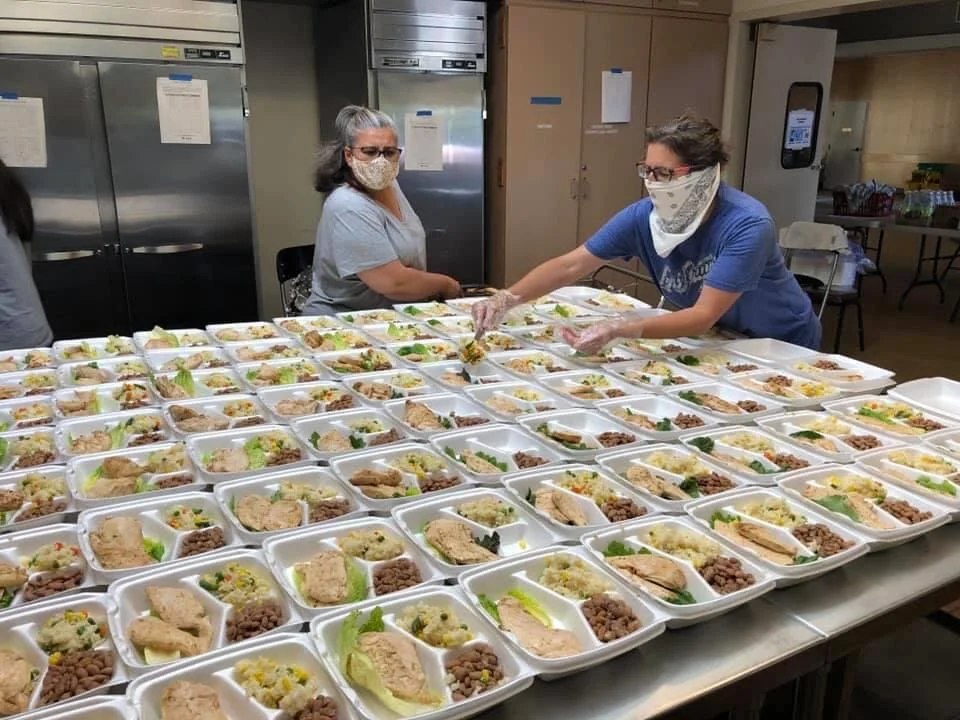
A modern-day equivalent of the “Feeding of the Five Thousand” has unfolded in the Eden Area over the course of the past two months under the banner “UIY Cena Caliente,” or in English, “UIY Hot Meals.”
The program was born out of suffering.
Two counselors from Tennyson High School (Diana, who is employed by the Hayward Unified School District, and the other, Elizabeth, who is employed by La Familia) reached to me and asked me to sponsor one of the World House students, so that they could during the pandemic.
You see, the counselors were getting calls from their students asking them where they could get something to eat, because they couldn’t go to their low-wage jobs to earn a few dollars an hour to buy their own groceries and make their own food.

2020.06.07 | Imago Dei
I hope. I pray. That we have finally reached a “tipping point” in the United States of America in which a critical mass of people acknowledge that racism is alive and well, and deeply embedded in our culture--and they, that we, have got to do our part to name it and eradicate it.
Yes. I hope, and I pray that we have reached a “tipping point” in which enough White people are committed to consistently and persistently doing our own work of self-reflection, confession, and contrition, so that these heinous crimes, the militarization of law enforcement, the perpetuation of the school to prison pipeline, the profiteering of private prison systems, and the cycle of oppression that is grounded in White supremacy is undone.
Yes. I hope and I pray that enough White people--and people from every other racial and ethnic group in this country--will no longer tolerate a white supremacist in the White House.