2026.04.12 | Open Doors
“Open Doors”
A sermon preached at Eden United Church of Christ
in Cherryland, California,
on Sunday, April 12, 2026,
by the Rev. Brenda Loreman
Second Sunday of Easter
Scripture: Luke 24:13-45
About 20 years ago, the United Church of Christ decided that it needed better marketing. Denominational leaders sat down with some marketing professionals and designed a fresh new visual identity, plotted out an advertising campaign, and developed a catchy slogan that they hoped would say something about who we were as a church community. Does anyone out there remember what the slogan was? “God Is Still Speaking,”
At the time that the slogan was launched, I was teaching high school English, and, although I liked how the slogan captured our open-mindedness as a denomination, the comma at the end drove me crazy! But the comma was the point—that God had more to say to us than just what was in the Bible. That God is speaking to us today, in all sorts of ways. That we are a people on a journey of spiritual exploration.
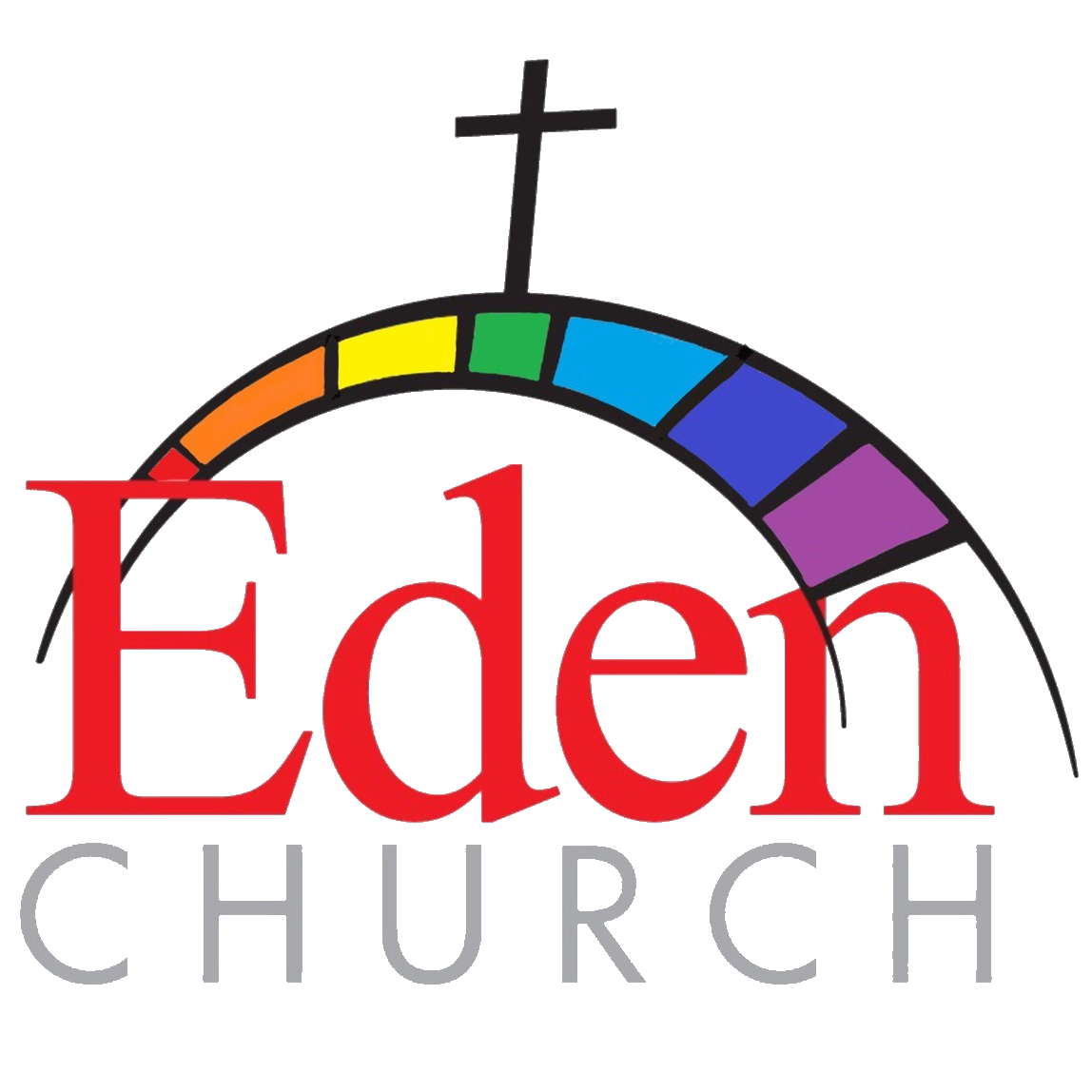
To capitalize on the new identity launch of the denomination, Eden church did some branding work ourselves, and collaborated with some marketing folks to create a fresh new logo. It echoed the black and red colors of the Still Speaking campaign, and included a stylized arch that reflected the brand-new arch at the entrance to the plaza on the corner of Birch and Grove, which had recently been added to the campus as part of our building remodel.
It was an exciting time for the denomination, and for us as a congregation. What I didn’t realize was that we were not the only mainline denomination creating identity slogans in the hopes of branding ourselves for new visitors. We were definitely part of a trend. The ELCA, the Evangelical Lutheran Church in America, which is the liberal/progressive expression of Lutheranism in the United States, chose the motto: “God’s Work, Our Hands.” The Episcopal Church motto was “The Episcopal Church Welcomes You.” And the United Methodist Church came up with “Open Hearts. Open Minds. Open Doors.”
As much as I loved our “Still Speaking” slogan, I really like the Methodist motto. And this week, as I’ve been pondering the resurrection appearances of Jesus in the gospels, I think their slogan really captures something about what the disciples have to do in order to get their hands around the news of the resurrection. They have to open their closed hearts and minds. And they have to push through their fear and open the doors they're hiding behind.
Openness is a good thing. In psychology, openness is “a basic personality trait associated with receptivity to new ideas and new experiences.” Being open to new experiences is “associated with creativity, curiosity, and a hunger for knowledge and learning,” and is also “correlated with higher measures of well-being, including overall happiness.” (1)
Openness is also a social concept:
We live in an age of open networks, open sources, open education, open information, open AI, and open access. [...] Some social scientists argue that “open organizing” is one of the primary principles of our times. While we might argue about what can and should be considered in the domain of openness, there isn’t much argument that ours is a world where the quest for openness across all areas of human experience is pressuring borders, boundaries, and walls of all sorts. An open society prizes inclusion, transparency, collaboration, and community. (2)
But when we are living in fear, or experiencing grief, or full of anxiety, or reacting to trauma, we tend to close down. We close off our hearts to dull the pain. We narrow our thinking. We build walls, and shield ourselves behind locked doors. Which is exactly what the disciples have done.
The two disciples traveling to Emmaus have hearts full of grief and sorrow. Even the “stranger” they meet can see it on their faces. And in their grief, their hearts are so shut down that they can’t even recognize the risen Jesus when he walks up next to them. They don’t recognize him as he interprets the scriptures to them. It is only in the sacred act of breaking bread together that he is made known to them.
The other disciples, who have remained in Jerusalem, clustered fearfully behind closed doors, have also closed their minds in disbelief. Luke’s version of the resurrection story says that the disciples do not believe that the women have witnessed an empty tomb. As Luke remarks, “But these words seemed to them an idle tale, and they did not believe them.” (3) They are fearful, confused and perplexed.
Even when Jesus shows up among them, saying, “Peace be with you,” they seem even more frightened, and the fear obscures their ability to understand. It is only through the sharing of the meal that they are able to release that fear and have their minds opened again. After all, the trait of openness to new ideas and experiences was surely part of why they became disciples of Jesus to begin with.
As Pastor Marvin reminded us last week in his Easter sermon, resurrection is about audacious hope—not an apathetic, passive hope that sits around and waits for things to get better, but “a hope that gets up, and goes, and looks—in the faces of neighbors, in the hands of strangers, in every act of mercy and resistance and solidarity that refuses to believe the tomb has the last word. Because resurrection is not just something we believe, it’s something we live. [...]—not just remembering, but making Christ present among us.”
But the disciples hadn’t discovered that yet. They were still believing that the tomb was having the last word. They needed a reminder from Jesus, their risen Lord, to open their hearts and minds, to open the door, and to get back to the work that he taught them—the work of building the kingdom of God. As he did with the disciples in Emmaus, he reminds the disciples in the room what Pastor Marvin reminded us of last week— that the good news of the gospel is more alive than anything that tries to kill it, that it is alive in each of us, and that resurrection is happening, right here and now, available to us if we have the openness to sense it.
A few years ago my predecessor, the Rev. Pepper Swanson had a brilliant flash of insight about our Eden logo. She realized that if she added some vertical lines to the archway, she could create seven sections—one for each color of the rainbow. So she did. And our logo was renewed and refreshed, offering another layer of meaning to it. Our rainbow-fied logo offers a sense of openness and affirmation that the original logo didn’t quite communicate.
As part of a capacity-building grant that we received recently, we’ve had the opportunity to once again work with some marketing professionals to refresh our branding. And our Eden Church logo has received a little glow up. Here it is.
At first glance, it may not look especially different, but there are some important changes. We’ve done away with the black, grey, and red of the original lettering and archway and made all of it black. The fonts have also been refreshed. They are now fonts that are readily available in the office applications we use, so we can use the fonts across all our documents and media.
The archway is no longer floating over the Eden name, but is now anchored to the name. The tagline below the logo — Love. Justice. Community.— are the three words you all mentioned most in your feedback after our all-church renewal retreat last September.
And there’s one more important element that was added. Have you noticed it yet? Can you see the open door inside the “n”? This open door image adds yet another layer to our beloved logo, and gives us something to ponder: Are we standing on the outside of the door, being welcomed in? Are we standing inside the door, opening it to welcome in the stranger? Or are we opening the door to the world, preparing to get up and go out there, carrying our resurrection hope into the world? I think it gets to be all three at once.
Resurrection is a door opening. It is openness to the wild, unpredictable, confusing, tale of the women on that first Easter morning, and the unbelievable, heart- and mind- opening story of the disciples from Emmaus, rushing back to Jerusalem to share the news: the tomb really is empty; Jesus is really alive in the world. Every wall is torn down, every boundary is dissolved, every lock is broken, every door is thrown wide open. We humans long for such openness—and Jesus offers it to us. Open hearts, open minds, open doors. (4) And—as always—God is still speaking. Amen.
1. “Openness,” Psychology Today. <https://www.psychologytoday.com/us/basics/openness> Accessed on April 11, 2026.
2. Diana Butler Bass, A Beautiful Year (New York: St. Martin’s, 2025), 202-3.
3. Luke 24:11, NRSVUE.
4. Bass, 206.